
How Pure Can Omega-3 Get with Fish Oil Molecular Distillation—And Where’s the Bottleneck?
Many people hear “molecular distillation” and assume it can magically turn any fish oil into ultra‑high‑purity EPA/DHA. In reality, very high concentration is achievable, but the ceiling is defined by chemistry, heat sensitivity, and equipment-level mass transfer limits. This article explains the realistic purity range and what truly holds it back.
Omega‑3 purity: Are we talking about “EPA+DHA content” or “chemical purity”?
In the Omega‑3 market, “purity” usually means the percentage of EPA and DHA in the final product (for example, an oil labeled 70% Omega‑3). But chemical purity can also mean low levels of oxidation products, low odor compounds, and compliance with safety limits for contaminants.
Molecular distillation is mainly a separation and polishing step. It can help raise EPA/DHA concentration and remove volatile impurities—especially when the feed has already been pretreated (degumming/neutralization, drying, winterization, etc.).
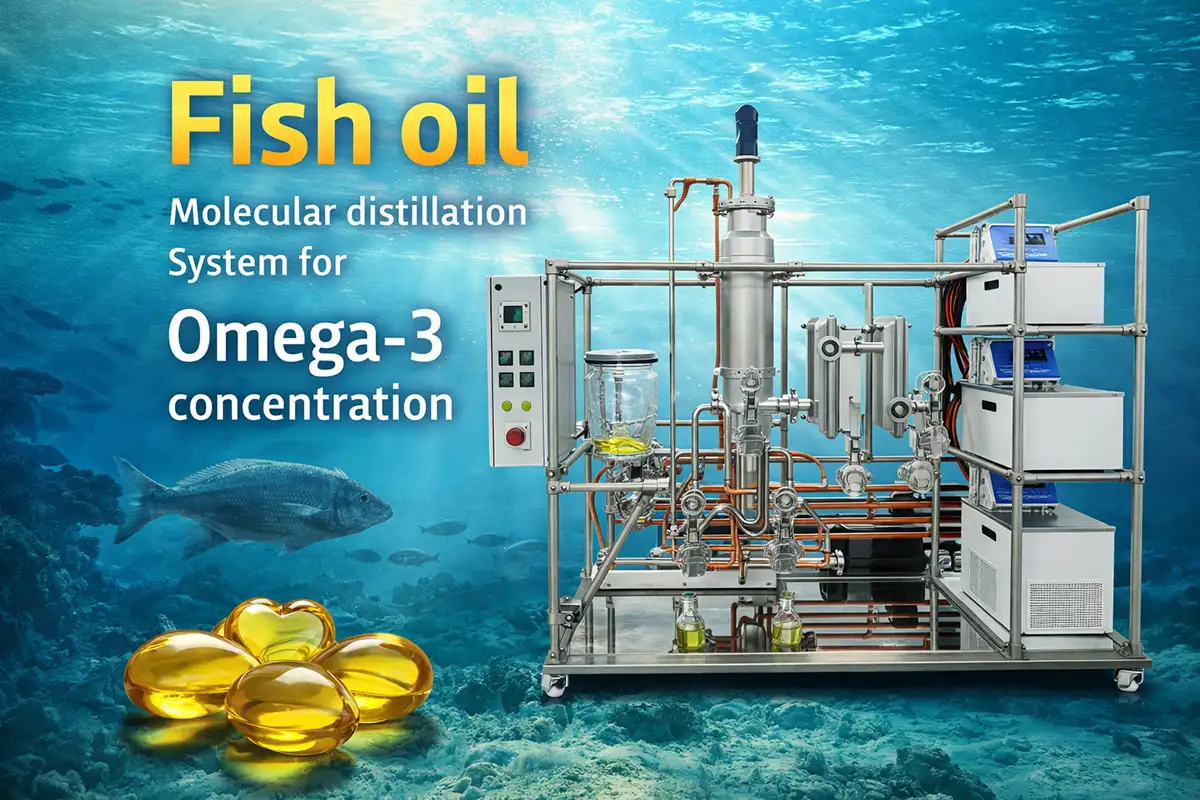
So, how high can Omega‑3 concentration realistically reach?
For fish-oil-derived concentrates, molecular distillation is commonly used to move from “standard” oils to high-concentrationOmega‑3 fractions. In practice, achievable targets depend on feed type (triglyceride vs ethyl ester), pretreatment quality, and how many stages/passes are used.
From an equipment perspective, the answer is usually no. Molecular distillation can concentrate effectively, but “nearly 100%” Omega‑3 generally requires additional fractionation strategies (multi-pass designs, different unit operations, or specialty purification routes). The limiting factor is not only the machine—it’s also the overlap in volatility among similar fatty acid species, plus the need to avoid thermal/oxidative degradation while chasing extreme cut points.
A key reason molecular distillation is favored is that it runs at very high vacuum, lowering boiling temperatures and reducing exposure time. This matters because EPA/DHA are heat- and oxygen-sensitive.
For authority context on why oxygen control is critical, GOED (Global Organization for EPA and DHA Omega‑3s) publishes industry guidance and quality expectations for Omega‑3 oils, emphasizing oxidation management as a central quality requirement. (Source: GOED monographs and quality resources.)
The real bottlenecks: what stops purity from rising further?
When purity plateaus, the root cause is often one (or more) of the following:
1) Boiling point overlap (separation physics)
Many fatty-acid-related compounds have similar volatility under vacuum. The closer their properties, the more stages (or sharper operating control) are needed to separate them cleanly.
2) Heat history & oxidation (product stability)
Even if higher temperature could improve separation, pushing too hard increases the risk of oxidation and polymerization, hurting taste, color, and quality indicators (peroxide/anisidine values).
3) Mass transfer limitations (equipment behavior)
If the film is uneven, too thick, or residence time is too long, separation efficiency drops and thermal stress rises. This is where wiped film design, rotor speed, and stable vacuum control matter.
Not always. In many projects, the bottleneck is feed preparation (water, soaps, waxes, or oxidation products entering the unit), which destabilizes vacuum and fouls heat transfer surfaces. A well-configured molecular distillation system performs best when upstream steps deliver a dry, clean, and consistent feed.
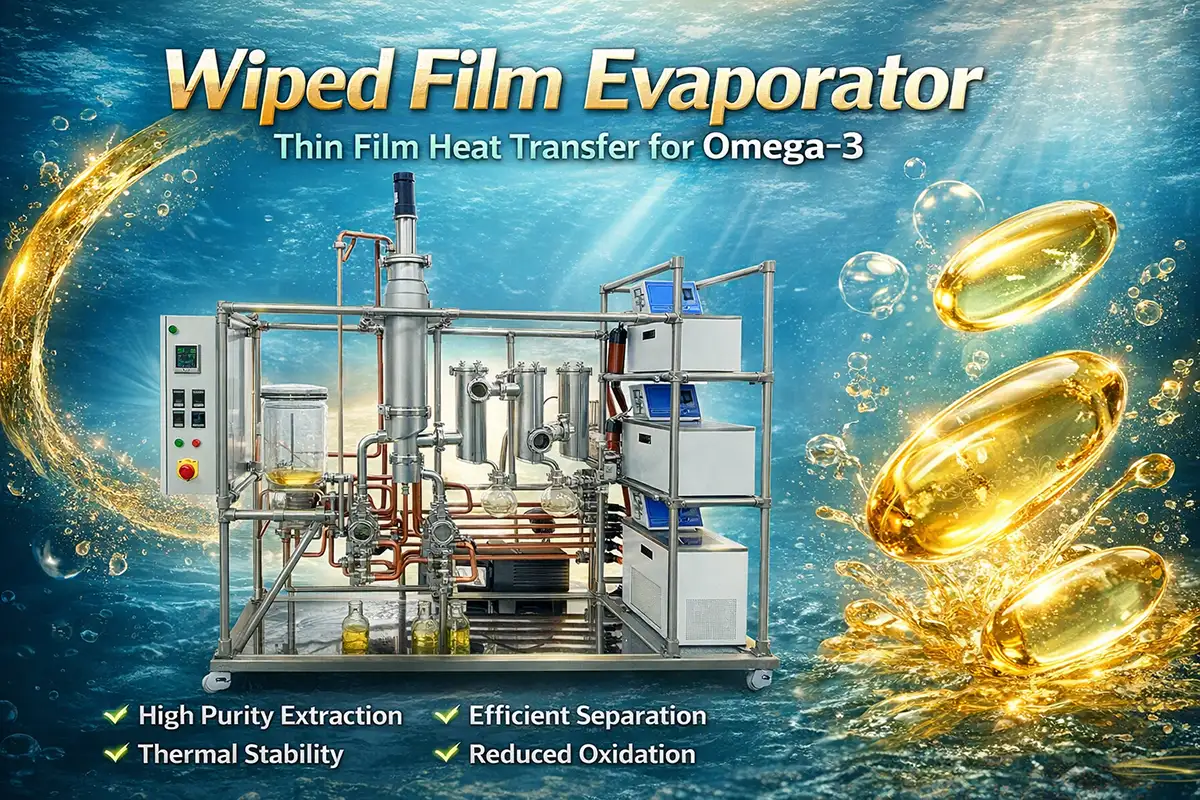
Equipment choices that directly impact Omega‑3 results
For fish oil, the practical goal is often: high vacuum stability, thin-film renewal, controllable feed rate, and gentle thermal handling. That’s why wiped-film-style molecular distillation systems are widely used for Omega‑3 concentration and deodorization.
For readers comparing concepts, the relationship between wiped film and short path is often confusing. A clear explanation is here:short path evaporation vs wiped film evaporation. For a deeper dive on how the thin film actually works, this guide helps:wiped film evaporator working principle.
From my experience explaining systems to buyers, the most decisive parameter is usually a combination: stable high vacuum plus a consistent thin film. High rotor speed capability and properly matched feed rate help maintain that thin film, which improves mass transfer while keeping residence time short.
Below is a simplified view of typical stainless-steel molecular distillation models and operating ranges (example equipment data). The key takeaway is not just “bigger is better,” but that evaporation area and feed rate must match the process target.
| Model | Main Evaporator Ø (mm) | Effective Area (m²) | Feeding Speed (kg/h) | Max Speed (rpm) |
|---|---|---|---|---|
| KDBM-60 | 60 | 0.06 | 0.5–3 | 450 |
| KDBM-80 | 80 | 0.10 | 1–5 | 450 |
| KDBM-100 | 100 | 0.15 | 2–8 | 450 |
| KDBM-150 | 150 | 0.25 | 3–15 | 450 |
| KDBM-200 | 200 | 0.35 | 5–20 | 300 |
| KDBM-230 | 230 | 0.50 | 8–30 | 300 |
Mobile note: the table is horizontally scrollable to keep the layout clean on phones.
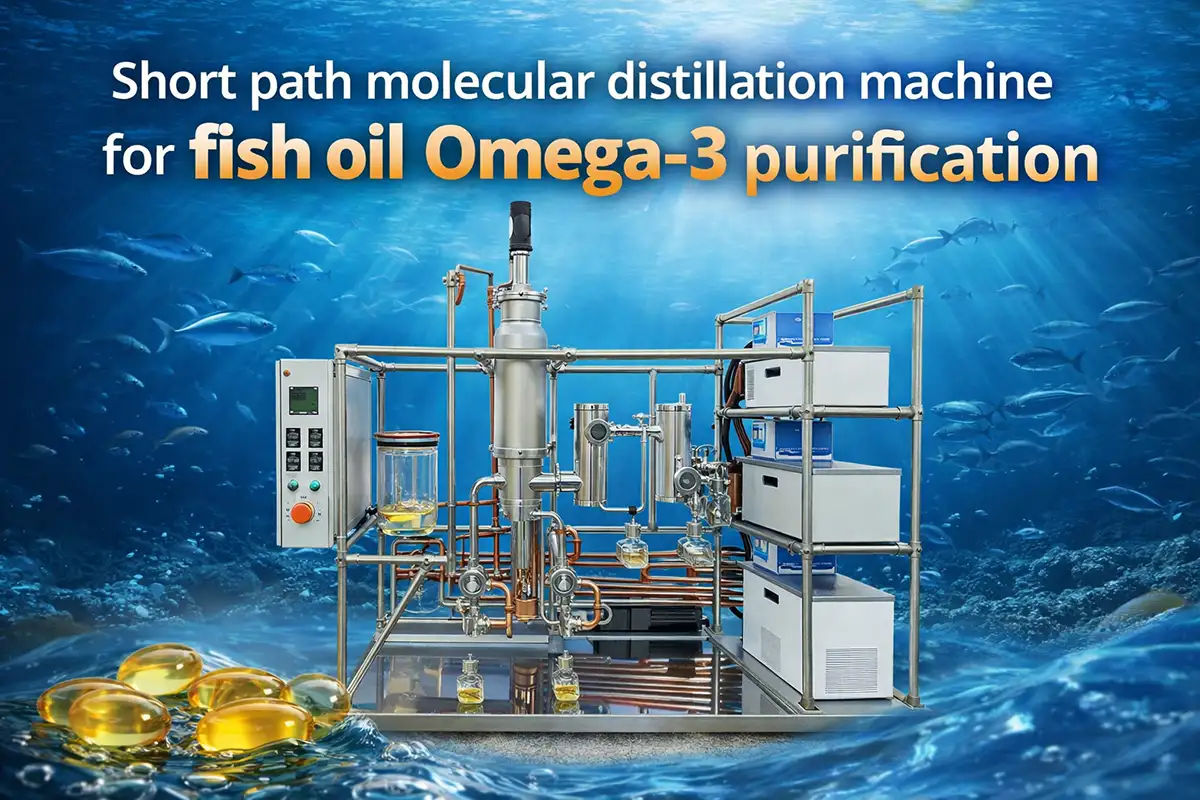
What “good” looks like: purity is not the only metric
In commercial Omega‑3 production, high EPA/DHA percentage is meaningful only if the oil still meets quality and safety expectations. For example, the European Food Safety Authority (EFSA) has published scientific opinions and assessments on Omega‑3 fatty acids, and the broader scientific consensus emphasizes that processing should preserve integrity while controlling oxidation.
That is why modern molecular distillation setups focus on process control: vacuum stability, low oxygen exposure, and short residence time. When those are done well, molecular distillation becomes a powerful “last mile” step to raise concentration while keeping sensory and oxidation metrics in range.
Choosing a molecular distillation system for Omega‑3: what to do next
If the target is higher Omega‑3 concentration with minimal thermal damage, the selection should start from the desired throughput and separation sharpness, then match evaporation area, rotor speed capability, and vacuum configuration accordingly.
Relevant equipment pages:molecular distillation systemandshort path molecular distillation machine.
Summary: molecular distillation can drive Omega‑3 concentration very high, but the ceiling is set by volatility overlap, oxidation risk, and mass-transfer limits. The best results come from clean feed + stable vacuum + thin-film operation.