
Fish Oil Molecular Distillation: How to Reduce Peroxide Value & Oxidation Byproducts
Fish oil is valuable because of EPA and DHA—but these polyunsaturated fatty acids oxidize easily. During molecular distillation, the goal is to remove odors, contaminants, and unstable fractions without creating new oxidation products. This article explains what actually drives peroxide value (PV) up and how a well-designed molecular distillation system helps keep it down.
1) What PV and “oxidation byproducts” really mean (in plain language)
Peroxide value (PV) mainly reflects primary oxidation: early-stage peroxides formed when oxygen attacks unsaturated fatty acids. “Oxidation byproducts” often refers to secondary oxidation compounds (like aldehydes and ketones), which are responsible for rancid odor and taste.
Author’s perspective: In real production, PV control is not a single “magic setting.” It is the combined result of oxygen management, vacuum stability, thin-film quality, and fast throughput.
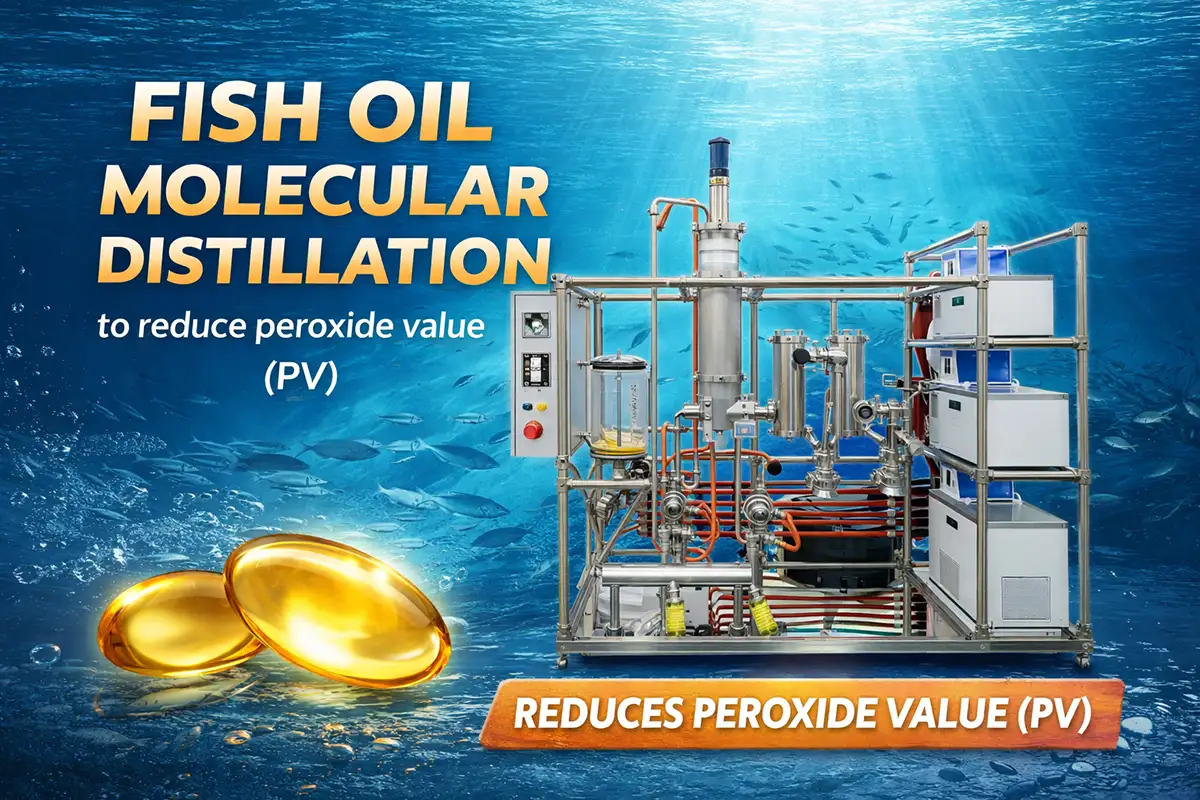
2) The practical levers: how to lower PV during fish oil molecular distillation
The biggest misconception is focusing only on “lower temperature.” Temperature matters, but PV often increases because oxygen gets into the process or the oil stays hot too long. Below are the levers that consistently work.
A. Keep oxygen out—before, during, and after distillation
Degas and blanketing: de-aerate feed oil and use inert gas (commonly nitrogen) where appropriate.
Seal points: minimize air ingress at pump seals, sampling ports, and receiving tanks.
Closed transfers: avoid open-to-air pouring; use closed piping and sanitary connections.
B. Shorten residence time with thin-film operation
The core advantage of wiped-film molecular distillation is forming a thin, fast-moving film on the heated surface. Less time at temperature means fewer oxidation reactions—especially important for EPA/DHA-rich oils. If thin-film behavior is unfamiliar, the wiped film evaporator working principlearticle provides a simple conceptual view.
Because PV can be created by oxygen already dissolved in the oil and by trace oxygen leaks that become significant over time. Vacuum helps, but it is not a substitute for degassing, leak-tight design, and short residence time.
C. Stabilize high vacuum to reduce thermal load
Better vacuum generally allows evaporation at lower effective temperatures. In molecular distillation, a stable vacuum also means more consistent separation and fewer hot spots from “overheating to compensate.” For equipment selection, a dedicatedmolecular distillation systemwith reliable vacuum components is usually the foundation for PV control.
D. Use throughput and rotor speed to avoid “overcooking”
From the equipment parameter ranges provided, typical wiped-film lab/pilot units run up to 450 rpm in smaller diameters (e.g., 60–150 mm) and up to 300 rpm in larger diameters (200–230 mm). Feed rates scale from about0.5–3 kg/h (60 mm) up to 8–30 kg/h (230 mm), with operating temperature capability of -90 to 220°C. These ranges matter because PV control is often achieved by selecting a combination of:
Higher effective evaporation area (more mass transfer per unit time)
Appropriate rotor speed (stable thin film, minimal stagnation)
Reasonable feed rate (avoid long hold-up volume and re-heating cycles)
3) Equipment parameters that help PV reduction (based on common stainless-steel units)
To keep oxidation down, it is helpful to size the evaporator so the oil can pass quickly as a thin film. The table below summarizes typical model ranges (diameter, effective area, feed rate, and rotor speed).
| Model | Main Evaporator Diameter (mm) | Effective Evaporation Area (m²) | Feeding Speed (kg/h) | Max Speed (rpm) | Feed Tank (L) | Collector (L) | Motor Power (W) |
|---|---|---|---|---|---|---|---|
| KDBM-60 | 60 | 0.06 | 0.5–3 | 450 | 1 | 1 | 90 |
| KDBM-80 | 80 | 0.10 | 1–5 | 450 | 1 | 1 | 120 |
| KDBM-100 | 100 | 0.15 | 2–8 | 450 | 2 | 2 | 120 |
| KDBM-150 | 150 | 0.25 | 3–15 | 450 | 2 | 3 | 120 |
| KDBM-200 | 200 | 0.35 | 5–20 | 300 | 5 | 5 | 200 |
| KDBM-230 | 230 | 0.50 | 8–30 | 300 | 5 | 5 | 200 |
Operational temperature capability: -90 to 220°C (system dependent). Voltage: 220V/50Hz (customizable). In practice, fish oil deodorization/purification often targets “as low as feasible” temperature while maintaining separation—enabled by vacuum and thin-film efficiency.
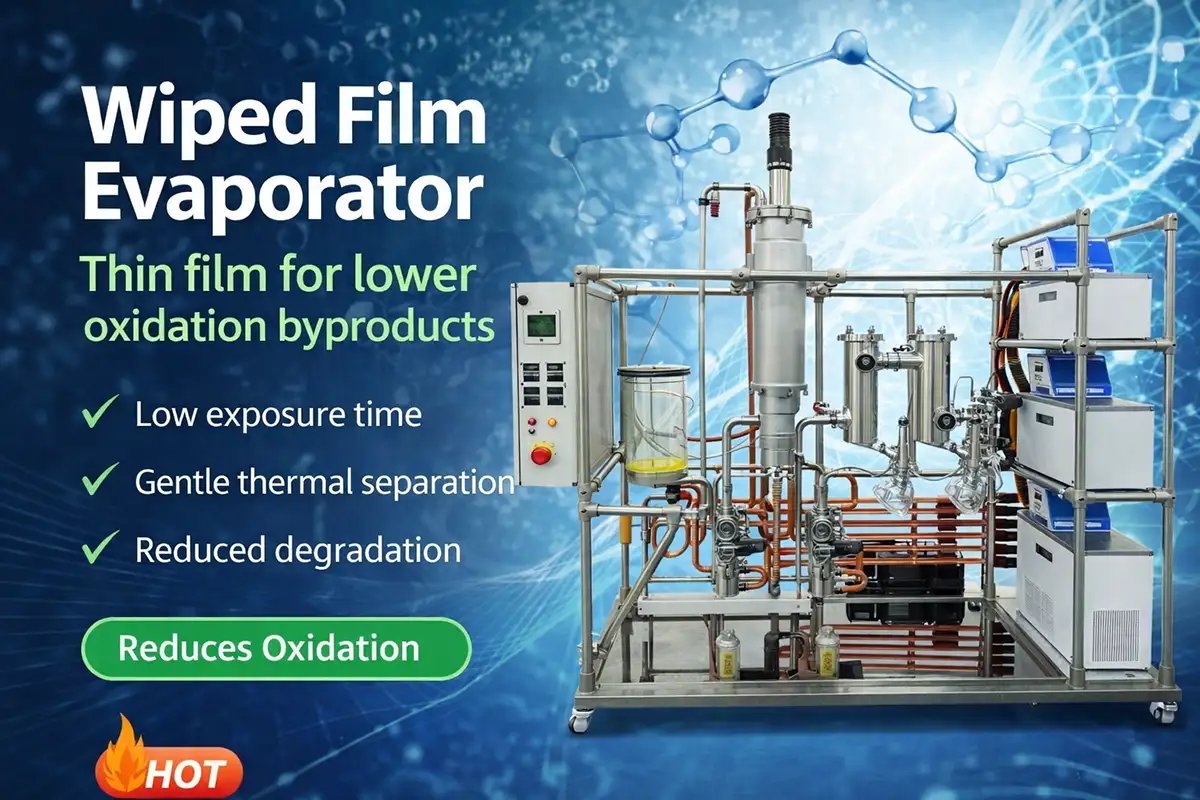
4) How to reduce secondary oxidation byproducts (odor compounds) without damaging EPA/DHA
Secondary oxidation compounds can be more noticeable than PV because they drive sensory rejection (rancid smell). Molecular distillation helps by removing more volatile fractions under vacuum. The key is to avoid conditions that create new aldehydes faster than they are removed.
Prevent hot spots: stable film wiping + correct rotor speed reduces localized overheating.
Keep passes minimal: multiple passes increase total heat history and oxygen exposure risk.
Fast condensation: efficient internal condenser reduces “back-mixing” of volatiles.
Not always. If temperature is lowered but the process becomes slow (longer residence time) or vacuum becomes unstable, total oxidation can worsen. The best outcome usually comes from balanced settings: strong vacuum, stable thin film, and fast throughput—so the oil spends less time under stress.
When comparing designs, it is useful to understand the distinction between short-path and wiped-film approaches. This reference on short path evaporationversus wiped film explains where each is typically strong.
5) A benchmark: what “good oxidation control” looks like
For finished fish oil quality, many buyers look for internationally recognized limits. For example, the Global Organization for EPA and DHA Omega-3s (GOED) publishes a widely used monograph with guidance values such asPeroxide Value (PV) ≤ 5 mEq O2/kg and Anisidine Value (AV) ≤ 20, and a combined oxidation index TOTOX ≤ 26 (where TOTOX = 2×PV + AV). These benchmarks help translate “less oxidation” into measurable targets.
From my experience, it is the ability to run high, stable vacuum while maintaining a uniform wiped film. That combination reduces the temperature needed for separation and minimizes time-at-heat—two direct levers that protect PV and limit new byproducts.
If PV is already high in raw oil, molecular distillation may improve odor and remove certain volatile oxidation products, but it should not be treated as a “cure-all.” The best strategy is prevention: low-oxygen handling, clean equipment, and controlled heat history.
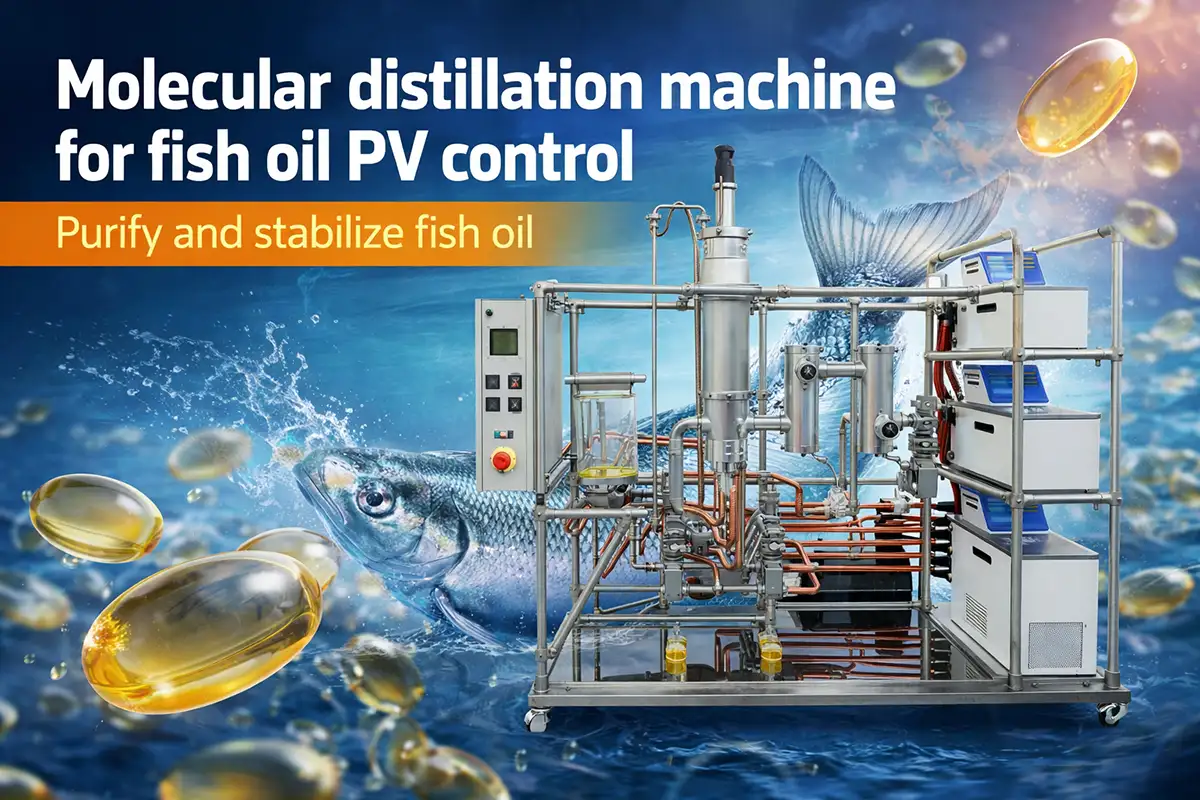
6) A simple checklist to lower PV during fish oil distillation
Start with low-oxygen feed handling: degas + inert blanketing + closed transfers.
Prioritize stable high vacuum: leak-tight connections, appropriate pumping, and steady operation.
Run thin-film, fast: correct rotor speed and feed rate to minimize residence time.
Avoid repeated heating: fewer passes and less hold-up volume reduce cumulative oxidation.
Verify with analytics: track PV, AV, and TOTOX against recognized benchmarks (e.g., GOED guidance).
Explore equipment options
For projects aiming to control PV and oxidation byproducts through short residence time and stable vacuum, see our molecular distillation systemconfigurations and sizing approach.