
Can Vitamin E Be Extracted from DDO by Molecular Distillation?
Yes—vitamin E (tocopherols/tocotrienols) can be enriched and separated from DDO using molecular distillation, especially when the goal is to protect heat-sensitive compounds while removing lighter volatiles and heavy residues. This article explains why it works, what conditions matter, and what kind of system parameters are practical.
The practical reason molecular distillation is a good fit for vitamin E
DDO (often discussed as a complex, high-boiling oil stream in processing industries) typically contains a wide distribution of molecules: light volatiles, mid-boiling fractions, and high-boiling residues. Vitamin E is comparatively heavy andthermally sensitive. Conventional distillation can push temperatures high enough to risk oxidation or decomposition.
Key idea: Molecular distillation runs under high vacuum and with a very short residence time, so the separation can happen at lower effective boiling temperatures and with less thermal stress.
Molecular distillation separates by “short travel distance”
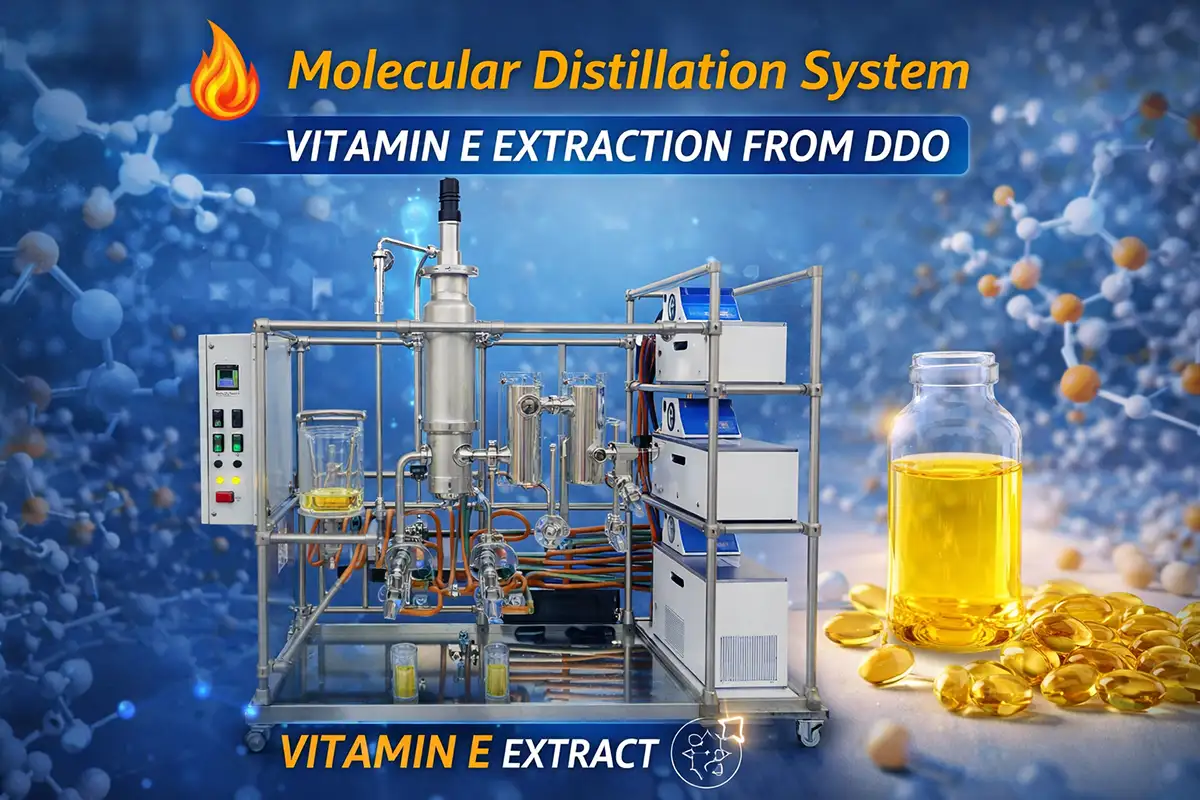
In a typical molecular distillation system, feed forms a thin film on a heated surface (often via a wiped film mechanism). Under deep vacuum, the more volatile components evaporate quickly and travel a short distance to a nearby condenser, where they re-liquefy as the distillate. Less volatile (heavier) components remain as residue.
For vitamin E in DDO, a common strategy is to remove undesired light fractions first, then tune conditions to enrich the tocopherol-rich cut while minimizing oxidation exposure. For background reading, see the internal guide on thewiped film evaporator working principle.
What “authoritative data” supports the need for gentle processing?
The challenge with vitamin E is not only separation—it is also stability. Vitamin E is known as a lipid-soluble antioxidant, yet it can still degrade under harsh processing conditions (heat + oxygen + time).
As a widely cited nutrition reference, the NIH Office of Dietary Supplements reports that vitamin E includes eight naturally occurring forms (four tocopherols and four tocotrienols), with α-tocopherol being the form maintained in human plasma and the one most often referenced for activity and labeling. Source: NIH ODS, “Vitamin E – Fact Sheet for Health Professionals.”
This matters in equipment selection: when product value is concentrated in specific forms, a process that minimizes thermal and oxidative stress becomes more than a “nice-to-have.”
What a practical molecular distillation setup looks like
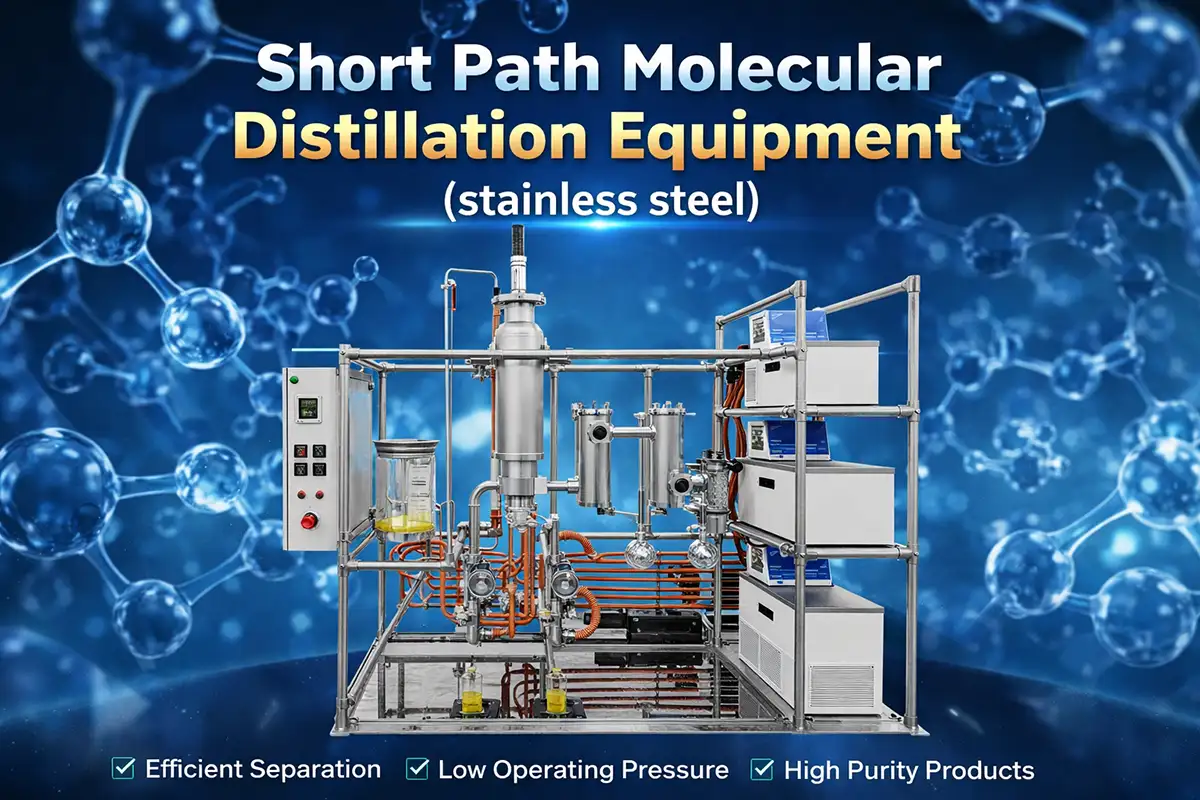
For vitamin E from a heavy oil stream like DDO, throughput, film quality, and temperature control are the core variables. Below is a concise view of stainless-steel molecular distillation models and operating ranges (from the provided equipment parameters). The operating temperature range is -90 to 220 °C, which offers flexibility for staged fractionation.
| Model | Main Evaporator Diameter (mm) | Effective Evaporation Area (m²) | Feeding Speed (kg/h) | Max Speed (rpm) | Motor Power (W) | Feed Tank (L) | Collecting Bottle (L) |
|---|---|---|---|---|---|---|---|
| KDBM-60 | 60 | 0.06 | 0.5–3 | 450 | 90 | 1 | 1 |
| KDBM-80 | 80 | 0.10 | 1–5 | 450 | 120 | 1 | 1 |
| KDBM-100 | 100 | 0.15 | 2–8 | 450 | 120 | 2 | 2 |
| KDBM-150 | 150 | 0.25 | 3–15 | 450 | 120 | 2 | 3 |
| KDBM-200 | 200 | 0.35 | 5–20 | 300 | 200 | 5 | 5 |
| KDBM-230 | 230 | 0.50 | 8–30 | 300 | 200 | 5 | 5 |
Notes: Operating temperature range: -90 to 220 °C. Voltage: 220V/50Hz (customizable). In real vitamin E work, temperature and vacuum are tuned based on feed composition and target cut.
What conditions matter most for vitamin E from DDO?
From an equipment and application perspective, the “make-or-break” factors are usually:
Vacuum quality & leak tightness: deeper vacuum lowers thermal load and helps keep the product bright and stable.
Thin-film formation (wiped film): improves heat transfer and shortens residence time—critical for nutrient oils.
Stage strategy: use one pass to remove light volatiles, then a tighter cut to enrich vitamin E.
Oxidation control: inert gas blanketing, fast transfers, and minimal air exposure during collection.
For readers comparing configurations, the relationship betweenshort path evaporationand wiped film designs is worth understanding, because the choice affects film dynamics, maintenance, and scale-up logic.
So—can vitamin E be extracted from DDO by molecular distillation?
Yes. Molecular distillation is a proven, industry-standard approach for handling high-boiling, heat-sensitive oil fractions. For DDO-type feeds, it can be used to remove lighter impurities, separate heavy residues, andenrich vitamin E into a more valuable fraction—provided the feed contains tocopherols and is suitably pretreated.
When selecting capacity, the provided model range (KDBM-60 to KDBM-230) covers laboratory and pilot-to-small-production throughput, from 0.5–3 kg/h up to 8–30 kg/h, with effective evaporation areas from 0.06 to 0.5 m². For product development, starting with a smaller unit to map the fractionation window is often the fastest path to a stable SOP.
To explore configuration options, see the product overview for amolecular distillation systemand match the model to feed viscosity, target throughput, and cleaning needs.
Authoritative source cited
NIH Office of Dietary Supplements (ODS). “Vitamin E – Fact Sheet for Health Professionals.”https://ods.od.nih.gov/factsheets/VitaminE-HealthProfessional/