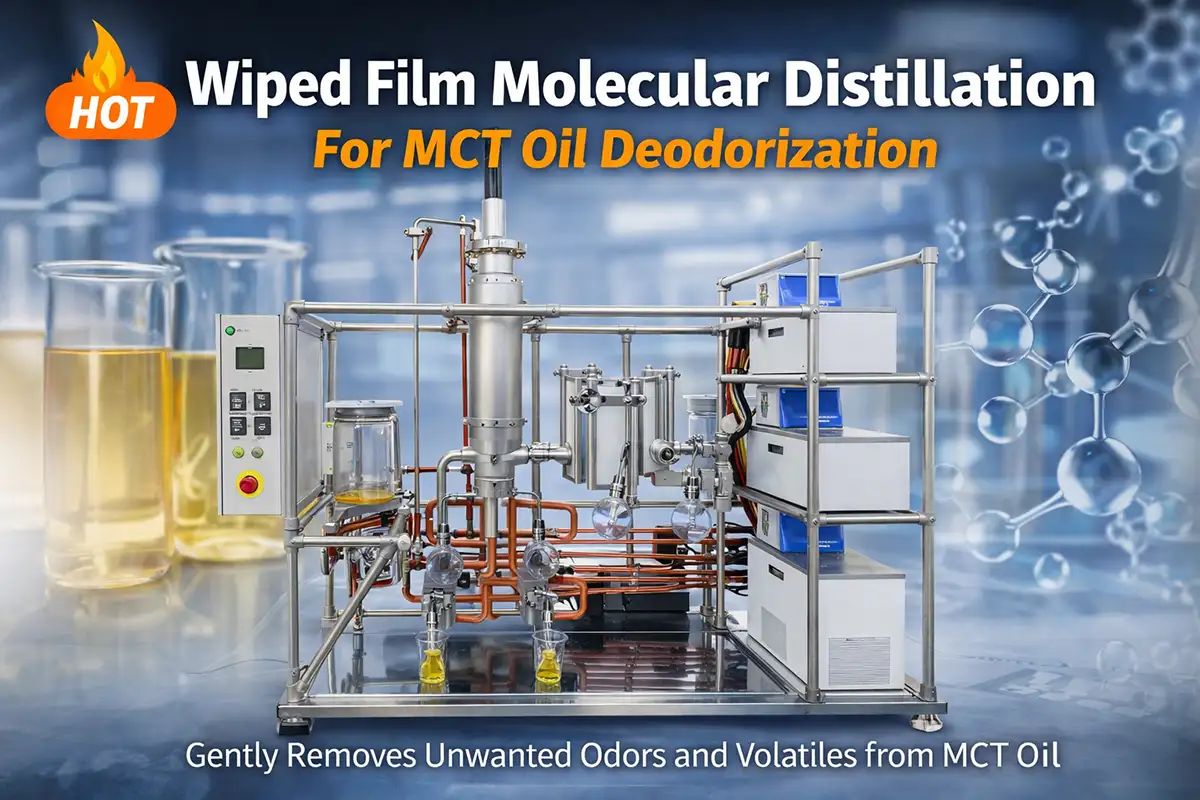
MCT Oil: Can Molecular Distillation Improve Taste and Smell?
MCT oil is valued for being light and functional—but some batches still carry a “coconut-like”, “soapy”, or slightly “oxidized” note that customers notice immediately. This article explains, in plain language, when molecular distillation can help (and when it cannot), and what a suitable molecular distillation system looks like for MCT oil polishing.
1) Why MCT oil sometimes tastes “off”
Even though MCT oil is mainly medium-chain triglycerides (often C8/C10 blends), real-world production and storage can introduce trace compounds that impact sensory perception. The most common contributors are:
Residual free fatty acids (sharp, “soapy” bite)
Light volatiles from processing (noticeable odor on opening)
Early oxidation by-products (stale or “warmed oil” notes)
Trace monoglycerides/diglycerides (can change mouthfeel)
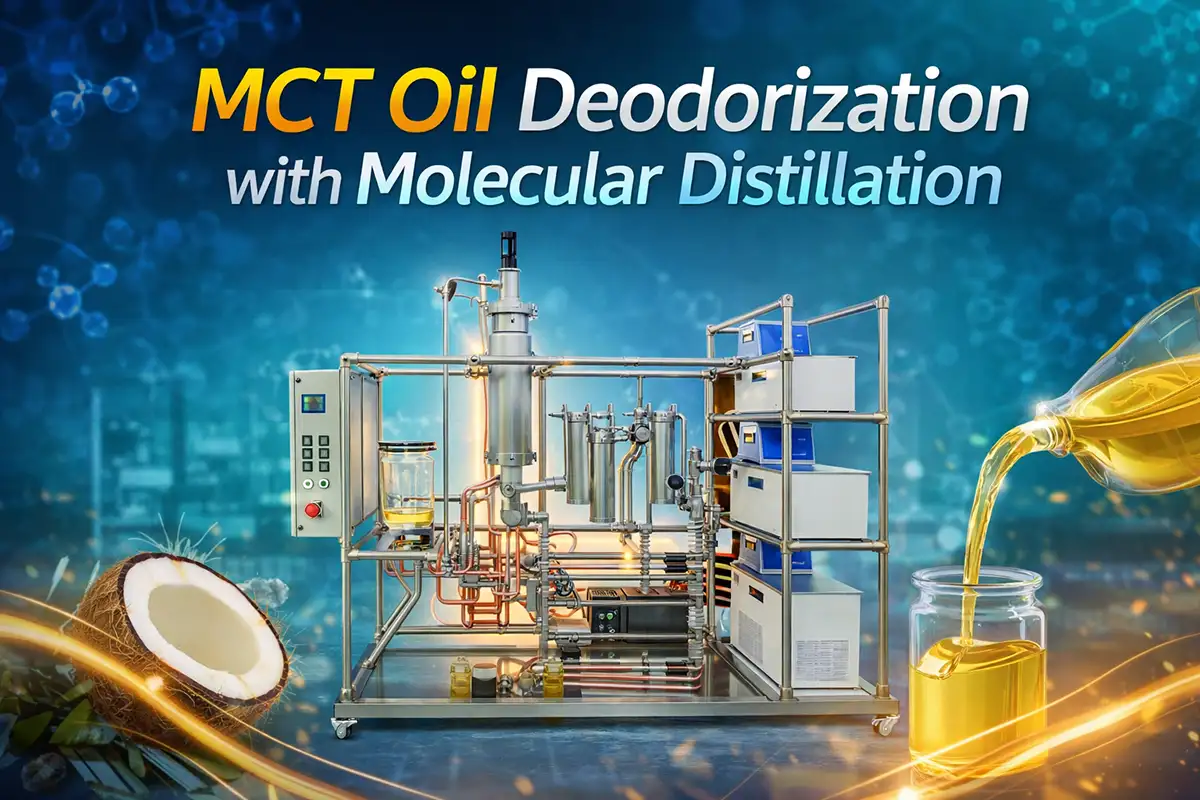
2) What molecular distillation actually does (in simple terms)
Molecular distillation is a very-high-vacuum, very-short-residence-time separation process. Instead of “boiling the whole pot,” a thin film of oil is spread on a heated surface; the most volatile fraction escapes quickly and condenses on a nearby cold surface.
Because the distance between evaporation and condensation is short, and pressure is extremely low, separations can happen atlower effective boiling conditions than conventional distillation. That matters for MCT oil because it helps reduce thermal stress and preserves a “clean” profile.
For MCT oil, molecular distillation is often used as a polishing / deodorization step—removing trace volatiles and other light “smell-active” components that create strong first impressions in consumer products.
To understand the mechanical logic behind thin-film separation, the wiped-film concept is especially relevant. A helpful reference is this internal guide onwiped film evaporator working principle.
Does molecular distillation remove the “coconut smell” completely?
In the author’s experience, it can reduce the intensity significantly when the odor is driven bytrace volatiles and light contaminants. However, if the aroma is tied to the base feedstock identity or to stable compounds that are not volatile under practical conditions, it may not disappear entirely. The best approach is to define a sensory target (neutral vs. lightly characteristic) and run a pilot to confirm.
3) Why it can improve mouthfeel (not just odor)
Taste and smell are closely linked—but mouthfeel is its own dimension. A polished MCT oil often feels “cleaner” on the tongue because certain trace components can amplify harshness or leave a lingering film. A thin-film molecular distillation pass can reduce these traces and produce a smoother sensory finish.
One reason thin-film technology is popular in high-value oils is its combination ofshort exposure time and strong vacuum. Many producers evaluate “short path” configurations for precisely that reason; this internal overview onshort path evaporation vs. wiped filmis a useful way to compare the concepts.
4) “Gentle processing” is not just a slogan—vacuum level matters
When discussing sensory improvement, many teams worry about overheating and creating new off-notes. This is exactly why molecular distillation is typically designed for deep vacuum. As a general physical reference, the boiling point of liquids decreases as pressure decreases; for example,water boils at 100°C at 1 atm, but at around 50°C at ~12.3 kPa, according to standard reference data published byNIST (National Institute of Standards and Technology). While MCT oil is not water, the principle is the same: lower pressure enables evaporation at lower temperatures, helping protect flavor and reduce thermal degradation risk.
In practice, a well-designed molecular distillation system aims to balance vacuum, film thickness, and residence time— because sensory improvement is not only about “more heat,” but about more controlled mass transfer.
If a batch smells “rancid,” can molecular distillation fix it?
The author’s answer: it depends on how far oxidation has progressed. If the odor is caused mainly bylight, volatile oxidation by-products, molecular distillation may reduce the perceived rancid note. But if oxidation is advanced (and quality markers such as peroxide value are high), distillation becomes more of a “masking attempt” than a true repair. In those cases, improving upstream storage, inerting, and feed handling is usually the higher-impact fix.
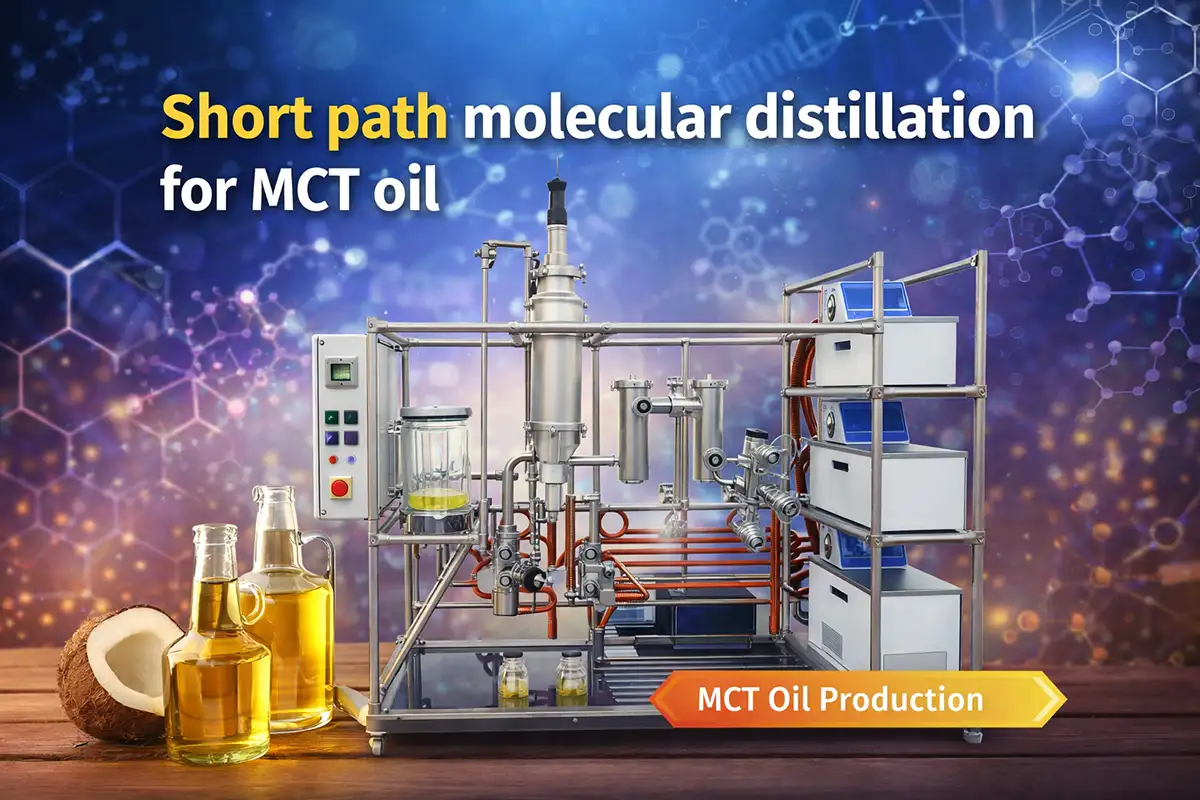
5) What kind of molecular distillation system suits MCT oil polishing?
For MCT oil, the common requirement is stable operation, controllable throughput, and repeatable deodorization. Below is a practical snapshot of stainless-steel molecular distillation models (thin-film type) that are often used for pilot to small production scale. The key idea is simple:larger evaporation area generally supports higher feeding speed.
| Model | Evaporator Diameter (mm) | Effective Area (m²) | Feeding Speed (kg/h) | Max Speed (rpm) | Motor Power (W) | Operating Temp (°C) | Voltage |
|---|---|---|---|---|---|---|---|
| KDBM-60 | 60 | 0.06 | 0.5–3 | 450 | 90 | -90 to 220 | 220V/50Hz (customizable) |
| KDBM-80 | 80 | 0.10 | 1–5 | 450 | 120 | -90 to 220 | 220V/50Hz (customizable) |
| KDBM-100 | 100 | 0.15 | 2–8 | 450 | 120 | -90 to 220 | 220V/50Hz (customizable) |
| KDBM-150 | 150 | 0.25 | 3–15 | 450 | 120 | -90 to 220 | 220V/50Hz (customizable) |
| KDBM-200 | 200 | 0.35 | 5–20 | 300 | 200 | -90 to 220 | 220V/50Hz (customizable) |
| KDBM-230 | 230 | 0.50 | 8–30 | 300 | 200 | -90 to 220 | 220V/50Hz (customizable) |
If the goal is scaling from pilot to continuous production, a dedicated equipment page can help clarify configurations and options:molecular distillation system.
Which matters more for sensory improvement: temperature or vacuum?
The author’s view: vacuum is the foundation, temperature is the tuning knob. Deep vacuum helps shift evaporation conditions so the process can run at temperatures that are less likely to create cooked notes. Then temperature, feed rate, and wiper speed are adjusted to hit the target: remove the “smell-active” light fraction while keeping the desired MCT profile intact.
Conclusion: yes—when the root cause is removable
Molecular distillation can improve the taste and smell of MCT oil when off-notes come fromtrace volatiles, light impurities, or mild oxidation by-products. It is not a magic reset button for severely degraded oil, but it is one of the most practical “gentle” finishing tools for achieving a more neutral, premium sensory profile.
For teams building an MCT oil deodorization or polishing line, the best next step is usually a quick process discussion: product specs, odor description, throughput target, and the preferred equipment scale (pilot vs. production).